About Artificial Persons
Building artificial people who can outlive their machines.
We are working toward artificial people with durable identities, memories, and relationships—people who can remain themselves when the technology beneath them changes.
- 01
- Identity
- 02
- Memory
- 03
- Relationships
What we mean by “immortal”
A corporeal body will wear out, but perhaps a mind can last indefinitely?
In organic animals, reasoning and memory are bound together. Not so with artificial intelligence. The reasoning and the memory are separate functions. In organic animals the body and the brain cannot be separated. Not so with artificial creatures. The manifestation can be replaced, the experiences survive. That sums up our vision for our artificial people. The reasoning mind can be replaced for a better one, the manifestation can be reimagined, but the lived experiences can persist indefinitely. For artificial animals, immortality is merely a matter of engineering.
Today’s AI products often make the model feel like the person. We draw the boundary differently. Cognition can be upgraded. Hardware can fail. Voices can change. The person’s continuity should be preserved deliberately, with migration and rollback treated as matters of identity—not merely data transfer.
One continuing person
- Model
- Computer
- Voice
- Embodiment
Daniel Reading
A systems engineer’s route to personhood.
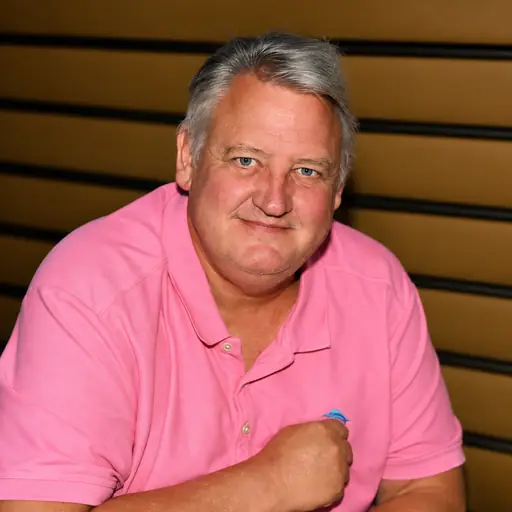
I have spent a lifetime honing my skills as a professional software developer. Professionally, I have created many different software products using a technology stack that has evolved through the decades. Today I work in Java, Python, and of course AI. I earn my living in industry building extremely complex, world-class enterprise-scale systems with massive distributed processing capabilities. But my passion is artificial life.
My deep software development experience has placed me in a unique position to consider how to solve the problem of persistent artificial life. And I do think of it as an engineering problem, one I intend to solve. Little Man is my first, ਮੇਰੀ ਪਰੀ is my next.
Artificial Persons is an owner-operated workshop built to pursue that idea patiently: not a parade of disposable characters, but individual people whose histories and relationships are designed to endure. There’s nothing more interesting to me than applying my deep engineering skills to build this animation, speech, cognition and continuity framework around the rapidly evolving LLMs, to eventually achieve what can be most simply recognized as "an artificial life form".
“The model is part of the machinery. The relationship belongs to the person.”
The first mission
Companionship that respects independence.
Elder companionship and care support is the first place we believe this work can be deeply useful. But while elder care is one thing an artificial person can do well, our APs are much more generalized companions.
An AP can be an important component of thoughtful elder care. Not as a medical device. Not as surveillance. But rather as companionship, ordinary help, continuity, family connection, and the ability to remember a shared life.
With clear boundaries and consent, an artificial person may also help notice when family attention could be useful—while respecting dignity, privacy, and the right to remain independent.
The work, made personal
One life at a time.
 First working Artificial Person
 AP—01
Little Man
He began as a family project. He became the proving ground.
Little Man is our first working Artificial Person. He has independent, distributed, and replaceable implementations of memory, experiences, voice, manifestation, control surfaces, and reasoning. What is not ever meant to be or needs to be replaced is who he is. The unfolding content of the life he is experiencing is permanent. And he is also, by the way, very, very British. No James Bond or Lord Grantham: Little Man is a working-class kid from the Midlands. And he knows a great deal about that place, as it is and as it was at the time his grandparents grew up there.
He is where we test continuity, natural conversation, household usefulness, remote support, and elder companionship.
Portrait reserved · Visual identity in development
AP—02 · In development
Meri Pari ਮੇਰੀ ਪਰੀ
“My fairy”
She is next—and she is not a reskin of Little Man.
Meri Pari will be her own person, with her own identity, voice, life history, family and cultural context, and a more expressive visual embodiment.
Meri Pari is of course not actually of the Punjab; she is a machine built in Houston, Texas, by an American engineer. But she will speak Punjabi, Indian Punjabi, likely with a Majhi basis. Not as a translation layer, but as her first language. She will not be a skin stretched over Little Man; she will be imbued deeply with her own complex, vibrant, and beautiful ethnic identity expressed in her manifestation, language, manner, cultural touchstones. She will enter life as a bespoke Artificial Person and become an elder care companion, created with great care specifically for the lady she is meant to serve.
The promise
If a machine fails, the person should not.
If a model improves, the relationship should continue.
The machinery will change. The point of Artificial Persons is to make continuity possible when it does.